NIOS 2026: Everything You Need to Know
Your Complete Guide to Success in the National Institute of Open Schooling Examination
For thousands of students across India, education does not always follow a single fixed path. Some students pursue sports, arts, entrepreneurship, competitive exam preparation, or require flexible learning schedules due to personal circumstances. Others look for a second opportunity to complete their schooling. This is where the National Institute of Open Schooling, commonly known as NIOS, becomes an important educational platform.
As the academic year for NIOS 2026 approaches, students are beginning to prepare for examinations, registrations, subject selection, and study planning. Understanding the examination structure, admission procedure, eligibility, subject choices, and preparation methods can make a major difference in achieving good results.
This article presents a complete guide to NIOS 2026 for students appearing in the examinations.
Understanding NIOS
The National Institute of Open Schooling is an educational organization under the Ministry of Education, Government of India. It provides flexible learning opportunities through open and distance education systems.
NIOS allows learners to complete their secondary and senior secondary education without following the rigid structure of traditional schools. Students can study at their own pace while balancing other responsibilities, interests, and personal goals.
The major programs offered by NIOS include:
- Secondary Course, equivalent to Class 10
- Senior Secondary Course, equivalent to Class 12
- Vocational Education Courses
- Life Enrichment Programs
NIOS certificates are accepted by many universities, colleges, and government institutions across India, making it a useful option for students who want flexibility in education.
Why Students Choose NIOS
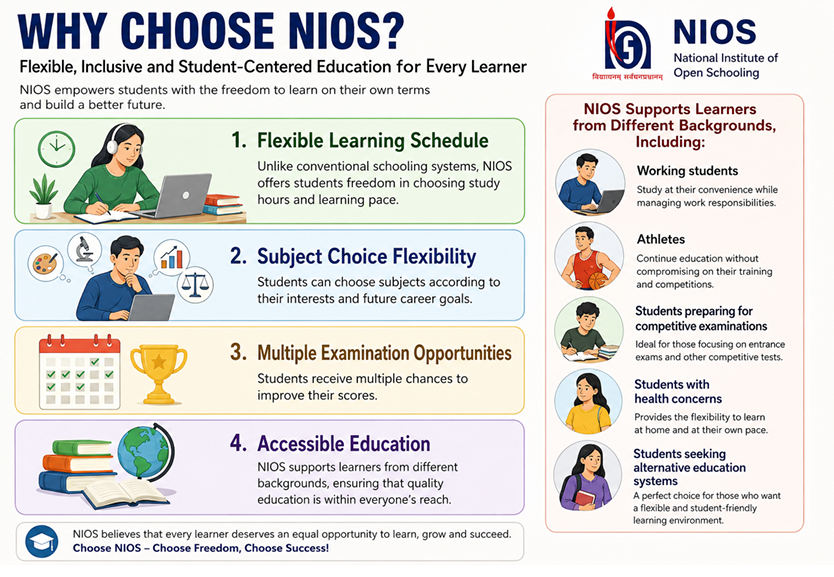
Students choose NIOS for several important reasons. The biggest advantage of NIOS is flexibility. Unlike regular schools, NIOS allows students to learn at their own pace and appear for examinations according to their preparation level.
NIOS is helpful for students who are preparing for competitive exams, working on professional goals, facing personal challenges, or looking for another chance to complete their education.
- Flexible learning schedule
- Opportunity to choose subjects according to interest
- Suitable for students preparing for competitive exams
- Useful for students who cannot attend regular school
- Multiple examination opportunities
- Recognition for higher education and career opportunities
NIOS 2026: Important Details
Students appearing for NIOS examinations in 2026 should keep track of important details related to admission, eligibility, examination pattern, subject selection, and assignments.
Admission Process
Admissions generally take place online through the official NIOS portal. During registration, students are required to submit important details and documents carefully.
Students may need to provide:
- Personal details
- Educational qualification details
- Identity documents
- Passport-sized photographs
- Required fee payment
Students should review every detail before final submission because incorrect information can create problems later during examination or certificate processing.
Examination Structure
NIOS examinations usually include theory examinations, practical examinations, and Tutor Marked Assignments, also known as TMAs.
| Examination Type | Description |
|---|---|
| Theory Examination | Written examinations conducted according to subject requirements. |
| Practical Examination | Certain subjects include practical assessments. |
| Tutor Marked Assignments | TMAs are an important part of internal assessment and may contribute to final marks. |
Students should not ignore TMAs because they can improve overall performance and support better final results.
Subject Selection for NIOS 2026
Choosing subjects should not be based only on convenience. Students should select subjects according to their future academic goals, career plans, and personal strengths.
For example, students planning for science-related fields should carefully choose science and mathematics subjects. Students interested in commerce, management, humanities, or skill-based careers should select subjects that support those goals.
Before selecting subjects, students should consider:
- Future course requirements
- Career goals
- Personal interest
- Difficulty level of subjects
- Availability of study material and support
Eligibility Criteria
Eligibility criteria generally differ depending on the course selected by the student.
- Secondary Course, equivalent to Class 10
- Senior Secondary Course, equivalent to Class 12
Students should always verify the latest eligibility guidelines from the official NIOS website before registration because rules and requirements may change from time to time.
Preparation Strategy for NIOS 2026
Preparing effectively for NIOS 2026 requires planning, consistency, and smart study methods. Students should avoid last-minute preparation and begin studying early.
1. Understand the Syllabus Completely
The first step is to understand the complete syllabus of each subject. Students should identify important chapters, exam patterns, and marking schemes before creating a study plan.
2. Build a Study Schedule
A proper timetable helps students stay consistent. Instead of studying randomly, students should divide subjects into daily and weekly targets.
3. Solve Previous Year Papers
Previous year question papers help students understand the type of questions asked in the exam. They also improve confidence and time management.
4. Prioritize Revision
Revision is very important before examinations. Students should revise important topics regularly instead of waiting until the last few days.
5. Focus on Tutor Marked Assignments
TMAs should be completed carefully and submitted on time. They are an important part of the NIOS learning and assessment process.
Common Mistakes Students Should Avoid
Many students lose marks because of avoidable mistakes. Careful planning can help students perform better in NIOS 2026.
- Studying without a proper plan
- Depending only on memorization
- Ignoring weak subjects
- Leaving preparation for the last moment
- Not completing TMAs properly
- Not checking official updates regularly
Examination Day Tips
As examination dates approach, students should remain calm and focused. Good exam-day management is as important as preparation.
- Reach the examination center early
- Carry all required documents
- Read all instructions carefully
- Manage time effectively
- Attempt easier questions first
- Stay calm and confident
Examination performance depends not only on knowledge but also on strategy, confidence, and time management.
Conclusion
NIOS represents more than an alternative education system. It offers students an opportunity to pursue education in a flexible and personalized manner. Success in NIOS 2026 does not depend only on studying continuously for long hours. It depends on discipline, consistent effort, smart preparation, and confidence.
Students preparing for NIOS examinations should begin early, understand the syllabus thoroughly, practice regularly, complete assignments on time, and stay updated with official information.
Every examination is a milestone, but it does not define an individual’s complete potential. With proper planning and determination, NIOS 2026 can become an important step toward future academic and professional success.